

What is an LMIA?
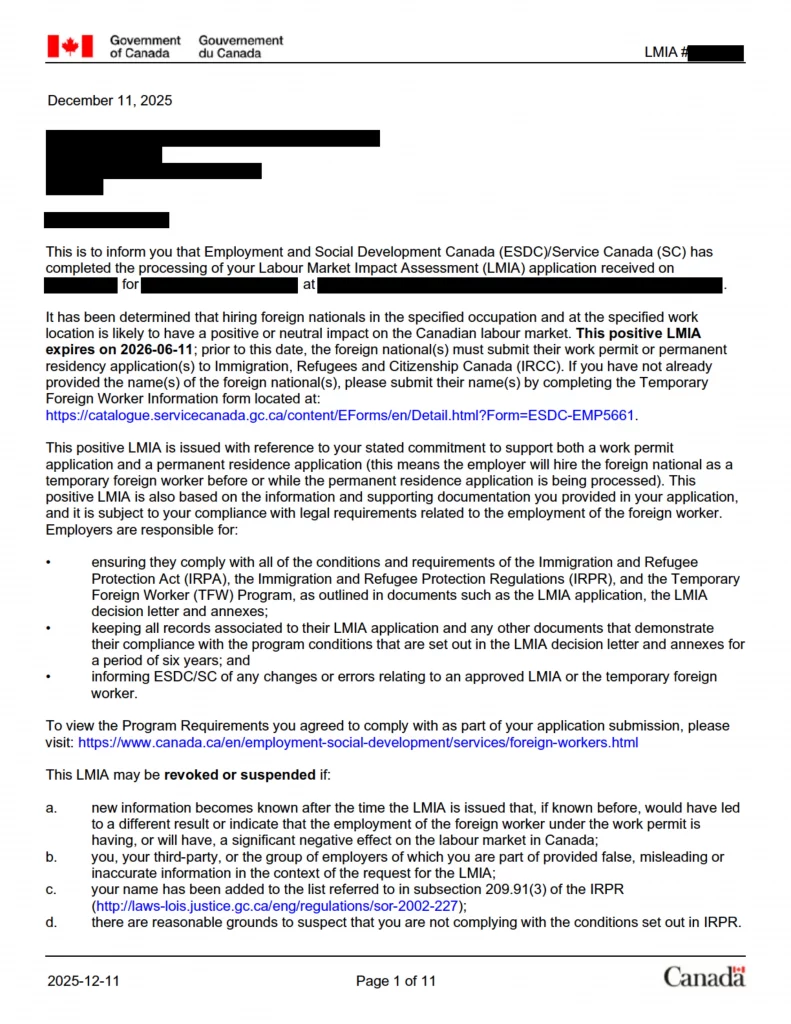
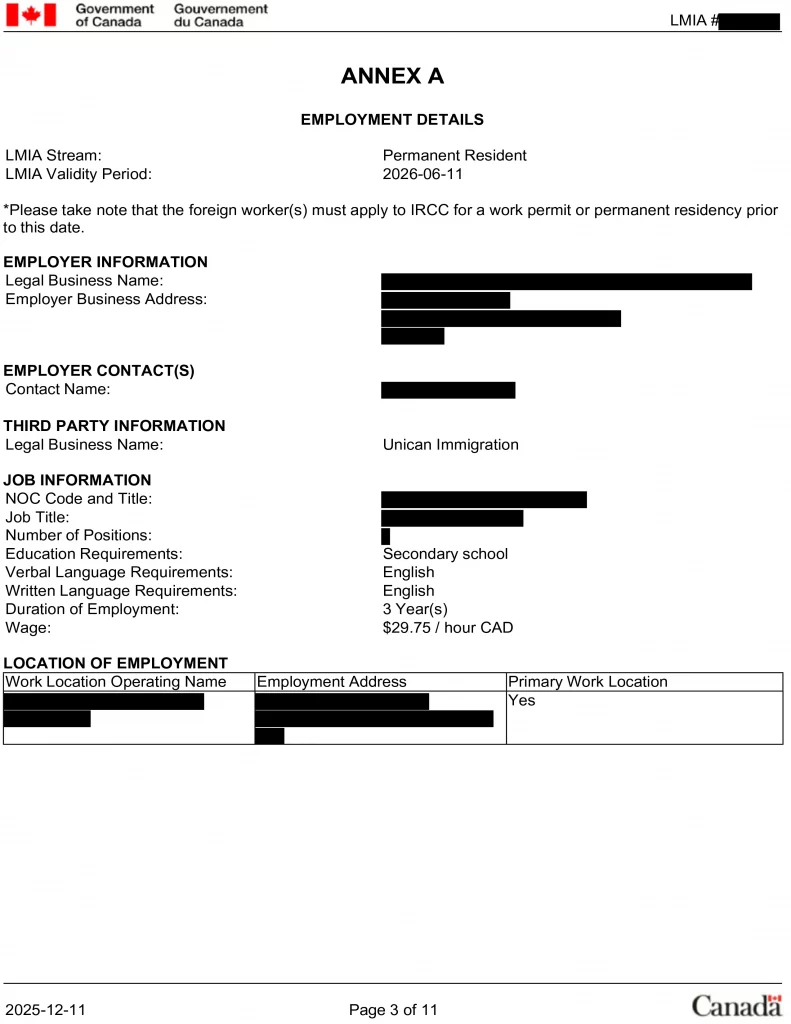
A Labour Market Impact Assessment (LMIA) is an official document issued by Employment and Social Development Canada (ESDC). It confirms that a Canadian employer is allowed to hire a foreign worker because no qualified Canadian citizen or permanent resident is available to fill the position.
In simple terms, an LMIA is the government’s way of protecting the Canadian labour market while still allowing employers to address genuine labour shortages.
A positive LMIA means the employer can move forward with hiring a foreign worker, who may then apply for a Canadian work permit.

Why Is LMIA Important?
LMIA plays a critical role in many Canadian immigration and work permit pathways. It is important because:
- It is required for most employer-specific (closed) work permits
- It allows employers to legally hire foreign workers
- It can support permanent residence applications
Without a valid LMIA, many foreign nationals are not eligible to work in Canada under employer-specific permits.
When Is an LMIA Required?
An LMIA is usually required when:
The work permit is tied to a specific employer
When your work permit is tied to a specific employer, it usually means that you cannot work for any other company in Canada without obtaining a new permit. In this case, an LMIA (Labour Market Impact Assessment) is often required to show that hiring a foreign worker will not negatively affect the Canadian labor market. The LMIA confirms that there is a genuine need for a foreign employee and that no Canadian citizen or permanent resident is available to fill the position.
Having an employer-specific work permit ensures that both the employer and employee are protected under Canadian labor regulations, and it helps the government monitor the hiring of foreign workers in sectors where Canadian workers are available.
The employer is hiring a foreign worker outside of LMIA-exempt programs
If an employer wants to hire a foreign worker outside of LMIA-exempt programs, they usually need to obtain a Labour Market Impact Assessment (LMIA). The LMIA process helps ensure that hiring a foreign worker will not negatively affect the Canadian labor market and that no qualified Canadian citizen or permanent resident is available for the job.
This assessment protects both employers and workers by verifying the need for foreign talent while maintaining fairness in the job market. Once the LMIA is approved, the foreign worker can apply for a work permit to legally work for that employer in Canada.
The position is not covered under international agreements or exemptions
If the position is not covered under international agreements or other LMIA-exempt programs, the employer must usually apply for a Labour Market Impact Assessment (LMIA). This ensures that hiring a foreign worker will not negatively impact the Canadian labor market and that qualified Canadian citizens or permanent residents are not available for the job.
The LMIA process provides a formal review of the employer’s need and protects both the worker and the local workforce. Once approved, the foreign worker can apply for a work permit to legally join the employer in Canada.
Most private-sector employers must obtain an LMIA before offering a job to a foreign worker.
Types of LMIA
There are different LMIA streams depending on the job and wage level:
High-Wage LMIA
For positions with wages at or above the provincial median wage. Employers must submit a transition plan to reduce reliance on foreign workers over time.
Low-Wage LMIA
For positions with wages below the provincial median. These applications have additional requirements and caps on the number of foreign workers.
Dual Intent LMIA
Allows employers to support both a work permit and a permanent residence application.
Permanent Residence Stream LMIA
Used to support foreign workers applying directly for permanent residence under specific programs.
LMIA Application Process (Step by Step)
The LMIA process is detailed and highly regulated. It typically includes the following steps:
- Advertising the job according to ESDC requirements
- Conducting recruitment efforts to hire Canadians or permanent residents
- Ensuring wage, job duties, and working conditions meet government standards
- Preparing and submitting the LMIA application
- Responding to ESDC requests or employer interviews, if required
- Receiving a positive or negative LMIA decision
A positive LMIA allows the foreign worker to apply for a work permit.
How an LMIA Immigration Consultant Can Help
Working with an experienced LMIA immigration consultant can significantly reduce risk. A consultant can:
- Assess employer and worker eligibility
- Develop the correct LMIA strategy
- Ensure full compliance with ESDC requirements
- Prepare and submit a strong application
- Communicate with government officers on your behalf
Professional guidance is especially important due to the complexity and scrutiny of LMIA applications
Need Help With an LMIA Application?
LMIA applications require precision, compliance, and a clear understanding of Canadian labour laws. A single error can lead to delays or refusal.
Contact Unican Immigration today to book a professional LMIA consultation and receive expert guidance at every step of the process.
Which regions have been added to the list, as of January 8, 2026?
No additional regions have been added to the list of CMAs with unemployment rates above 6%, although several areas from last quarter have experienced a rise in their unemployment compared to the previous period.
As of January 8, 2026, which regions will start processing LMIA applications for low-wage positions?
- Halifax, NS: 6.1 → 5.2
- Moncton, NB: 7.3 → 5.5
- Saint John, NB: 7.3 → 5.8
- Fredericton, NB: 6.7 → 5.2
- Kingston, ON: 6.6 → 5.6
- Winnipeg, MB: 7.3 → 5.7
- Vancouver, BC: 6.8 → 5.9
Although Montreal’s unemployment rate decreased from 6.7% to 5.5%, the suspension on accepting low-wage LMIA applications in the city remains in effect. Quebec has paused the processing of low-wage LMIA applications in the Montreal and Laval administrative regions until December 31, 2026.
Previously, job offers from these areas were ineligible for low-wage LMIA processing during the last quarter of 2025. However, they will become eligible for processing in the first quarter of 2026.
Need an LMIA for Your Job Offer?
If you’re an employer looking to hire a foreign worker in Canada, a Labour Market Impact Assessment (LMIA) may be required. The LMIA process ensures that hiring a foreign worker won’t negatively affect the Canadian labor market and confirms that no qualified Canadian is available for the position.